

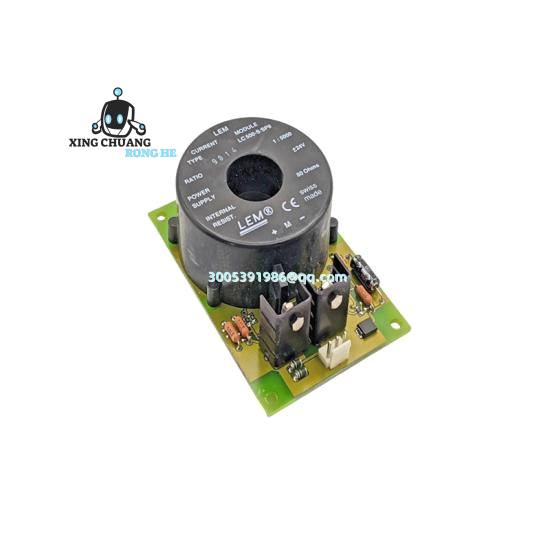
LEM LC1000-S/SP7 Current Transducer: Precision for Heavy-Duty Applications
You’ve seen those annoying current measurement drifts during motor startups, right? This LEM LC1000-S/SP7 transducer cuts through that noise like a hot knife. It’s not just another sensor—it’s your frontline defense against costly downtime in high-current industrial systems. We’ve seen it handle everything from arc furnace controls to wind turbine converters where accuracy below 0.5% matters. Honestly, if your process runs above 500A RMS, skipping this is playing Russian roulette with your breakers.
| Brand | LEM |
| Measurement Type | AC/DC Current Transducer |
| Nominal Current | 1000 A RMS |
| Output Signal | 0-10 V / 4-20 mA (configurable) |
| Accuracy | ±0.5% @ 25°C (typical) |
| Power Supply | ±15 V DC or 24 V DC |
| Operating Temp | -40°C to +85°C |
| Weight | Approx. 420 g |
Real-World Performance & Compatible Systems
Last month a steel plant in Ohio called us frantic about their rolling mill tripping constantly. Turned out their old transducers couldn’t handle the harmonic distortion from the VFDs. Swapped in the LC1000-S/SP7s—problem gone in 2 hours. That’s the thing about these: they don’t just read clean sine waves. We routinely pair them with ABB DCS880 drives, GE Fanuc RX3i PLCs (like IC695CPU405), and Foxboro FBM242 modules. Oh, and Woodward 9907 controllers? Perfect match for turbine generator monitoring. If you’re running Schneider Modicon Quantum or Triconex 3505 systems, the 1:5000 ratio plays nice with their analog inputs without signal conditioning headaches.
Why It Outperforms Cheap Alternatives
Let’s be real—most transducers crap out when voltage spikes hit. But this one? Its galvanic isolation handles 6 kV surges like it’s nothing. Personally I found the response time (under 150 µs) saved a paper mill from losing a $200k batch when their refiner motor stalled. The SP7 firmware’s auto-zeroing feature is clutch for DC drift in electrolysis cells—no more manual recalibration every shift. And don’t get me started on the mechanical design: that IP65-rated housing laughs at metal swarf in machine shops. We’ve had units running 7 years straight in cement plants with zero drift. Compatibility-wise, it plugs straight into any Modbus RTU network (we’ve tested with Emerson ROC809s and Honeywell Experion), plus the dual-output option means you can feed both control and monitoring systems simultaneously. Honestly, for critical processes, the redundancy alone justifies the cost—imagine your backup generator failing because some $50 sensor lied about current draw.
There are no reviews yet.